
An intuitive way to understand the Gospel
Okay - in this article we’re going to try to understand the gospel, in an intuitive way that stays honest to the biblical text. We’re going to rely less on “religious” words or phrases that often come with baggage we don’t even realise we’re carrying. This isn’t about stripping meaning away - it’s about clearing space so we can see, hopefully, a bit more clearly what’s being said.
So let’s dive in. To do that, we need some context first. We need to understand what reality is - and what our place as human beings is within it.
What is reality?
What does it even mean for something to be real?
When you think about reality, what comes to mind?
Do you think of it as something that exists independently of us - something we’re all participating in individually? Almost like a movie playing in a cinema. The movie exists. It runs whether anyone is in the seats or not.
Or do you think reality is shaped by us somehow? That nothing really exists apart from the observer? That truth is dependent on vantage point?
Imagine you and I are both sitting in that cinema. You think you’re watching a fantasy action movie about pirates. I think I’m watching a grounded science-fiction film set in space. Neither of us knows what the “true” movie is - because there isn’t one. Both perspectives are equally valid.
Or maybe you’ve gone further than that and decided reality itself is just a big illusion we’re collectively participating in - that nothing really is anything at all.
For the sake of this article, we’re going to focus on the first view - the idea that the movie is playing, that it exists whether anyone is there to see it or not. This has been the dominant way humans have understood reality for most of history, and it’s still how we live day-to-day, even if we question it philosophically.
What does that reality look like?
If that’s how you see it, what do you picture?
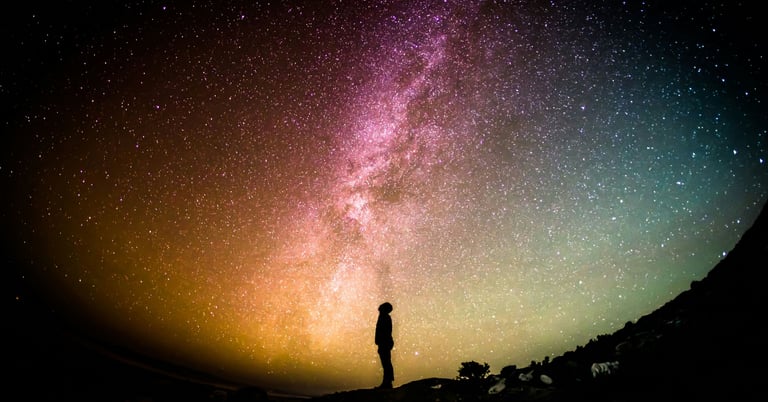
Maybe you imagine us living on a blue planet orbiting the sun, alongside seven neighbours - sorry again, Pluto. Zoom out and you see our sun as one of billions scattered across the Milky Way. Zoom out further and you see that as one of billions of galaxies in what feels like an endless expanse of space, matter, and energy interacting across time.
Do you picture space as a huge, empty room? Matter floating around inside it like helium balloons?
That’s a very natural way to imagine it.
But it turns out that picture is already wrong.
Space isn’t fixed. It bends. It warps. It stretches depending on the mass of the objects within it - something so strange we don’t really have a practical comparison for it.
Imagine that huge empty room again. There’s a balloon twenty metres to your left. You start walking straight to the right - and somehow still end up colliding with the balloon on your left, because the space between you is curved. That’s essentially how gravity works.
It’s deeply unintuitive.
And time doesn’t behave the way we assume either. It’s not just a background clock ticking away while things happen in space. Time and space are one and the same thing - a single fabric. Stretch space and you stretch time. Get close enough to mass or move fast enough and time itself slows down.
Past, present, and future aren’t as cleanly separated as our intuition suggests.
Then there are places where even this framework breaks down entirely.
Black holes. Singularities. The boundaries of the known universe. Points where our mathematics simply stop working. One of those singularities sits not at the edge of the universe, but at its very beginning - where space, time, matter, and energy all converge into something we can describe, but not understand.
That’s how reality behaves when it’s very big.
Now go the other way
Look at your phone.
You know it’s made of materials. Those materials are made of elements. Those elements are made of atoms. Those atoms are made of fundamental particles arranged in different ways.
But zoom in further and even those particles aren’t solid. At that level, everything reduces to fields - seventeen that we know of today. What we experience as particles are really just disturbances in those fields. Fluctuations of a certain kind, within a certain range.
At that scale, nothing is solid at all.
The physical world turns out to be more like stable patterns in something far stranger underneath. Imagine early-morning dew after a cold night - droplets becoming so fine they hang in the air as mist. Most droplets behave predictably. Some behave oddly. Those odd behaviours are what we’ve come to call particles.
At this level, certainty disappears. We don’t talk about what will happen - only what might happen. Probabilities replace predictability.
So when things get too big, our understanding breaks down.
And when things get too small, it breaks down again.
The unavoidable problem
Now you’re stuck with a conundrum.
You know reality involves fields producing matter and energy.
You know those fields exist within space-time.
You know space and time are one thing.
You know that thing is expanding.
Which means if you wind the clock backward, everything converges.
You can try to explain this away with mathematics, cyclical universes, multiverses, or infinitely fluctuating systems. But all of those merely push the same problem back a step. They don’t solve it.
The question remains.
What exists when all the things we know didn’t?
The Christian response
The Christian response is that everything we experience had an origin point. Which means there is something that exists when none of this exists.
That is fundamental reality.
But it’s not vague. Not inanimate. Not a force.
It is a person.
What does that mean?
It means this reality has intentionality.
It has will.
It thinks rational thoughts.
It has character, preferences, and identity.
It has a name - which means it isn’t really an “it” at all. It has disclosed itself historically as He. That has nothing to do with modern political categories about gender. It’s a claim about agency and personhood.
This being has immense creative power. Not just the power to rearrange existing things - but to cause space, time, and fields themselves to exist simply by intending them to.
Because He is fundamental reality, He has no beginning. He is uncaused. He does not change.
We cannot see Him with our physical senses - because a being who brought the physical universe into existence is not physical Himself. But that does not mean we do not experience Him. We experience Him through reason, conscience, beauty, love - with a depth and immediacy comparable to our five senses.
So who are we?
Now the question turns to us.
What are human beings?
Maybe you see us as immaterial, ethereal minds trapped inside biological cells.
Or maybe you see us as no different from animals - same essence, same family, same origin.
You might look at DNA similarities across life, fossil continuity, physical resemblances, and conclude that everything stems from the same thing.
Maybe you see life emerging from chemistry - atoms randomly arranging into molecules, molecules into compounds, compounds into living systems, given enough time and chance.
Maybe you see consciousness as just an emergent illusion - atoms colliding, hallucinating experience.
Many people end up there.
The Christian view of humanity
The Christian claim is that the same being who created everything structured reality both meticulously and indulgently - with extraordinary precision and beauty.
Like a potter shaping spinning clay, He formed reality in stages. Fields and space-time came into being. Stable matter formed. Chemistry emerged. Planets stabilised. Heat and cold balanced. Atmosphere developed. Life began.
It did not have to be this way. Infinitesimal changes would have resulted in nothing at all.
Then, at a particular moment, He did something new.
He took existing biological matter and imbued it with a limited version of His own kind of being - intentionality, will, rationality, moral awareness, creativity. Human beings.
Not infinite.
But real.
That’s why we are both similar to animals and radically different from them at the same time.
This wasn’t just functional. It was loving.
Humans were created to experience - in a limited way - the joy, love, creativity, and community that this being already possessed. And like a parent delighting in a child, He created us not only for our joy, but for His as well.
Male and female were created together to reflect that image, to spread it across the earth, to shape and steward creation, and to exercise real creative authority within it - like ambassadors operating in a sandbox entrusted to them.
Where it went wrong
And then things took a sharp left turn.
The first humans - biological beings carrying this image - chose autonomy. They decided to define morality, wisdom, and reality on their own terms.
Like a child confidently grabbing the steering wheel from a seasoned driver, with a different destination in mind, it was doomed from the moment it began.
We didn’t just break rules.
We severed relationship with reality itself.
The result was inevitable: pain, anxiety, injustice, decay, and death.
And none of us stands outside it. We all contribute - like participants in an economy. Some spend more, some less, but everyone keeps it moving.


The Gospel
At that point, the being did not abandon us.
He made a plan.
Slowly, deliberately, He began rescuing a remnant - shaping a people over time, working through history, preserving a line that would carry His intent forward. They failed repeatedly. His plan did not.
Eventually, He stepped into the world Himself.
In first-century Judea - obscure, politically insignificant, overlooked - He was born as a human being. Poor. Scandal-tinged. Unnoticed.
His name was Jehoshua, shortened to Jeshua, rendered in Greek as Iesous, and in English today, Jesus.
He lived within the same limits we do. And wherever He went, the effects of our rebellion began to reverse. The blind saw. The sick were healed. The dead rose.
He loved in a way broken humanity could barely comprehend.
And then He allowed Himself to be killed - not because He couldn’t stop it, but because He came to absorb the consequences of our choices. A self-sacrifice, out of love.
He was tortured and executed on a cross.
And then… He got up again.
He walked, ate, spoke, and met with those who loved Him, those who doubted Him, and even some who hated Him. Lives were permanently altered. Those who saw Him understood who He was - and what it all meant.
They didn’t keep it quiet.
They told everyone. They spread it as far and as wide as they could. They wrote it down. Made copies. Sent letters. Those further along strengthened those just beginning.
People saw it - not just in the words, but in the lives transformed by them. In ways that were both unexpected and impossible to ignore.
Those writings were gathered, carried, protected - passed from group to group in different arrangements - until they formed a collection of twenty-seven texts. That collection is what we now call the New Testament.
Alongside it sat another collection - one Jehoshua Himself upheld. Writings that explained the world, our condition, and pointed toward Him long before He arrived - creating an expectation only those willing to see could recognise. These Hebrew texts - the Torah, Nevi’im, and Ketuvim - are what we now call the TaNaKh or Old Testament.
Together, they form what many today call the Bible.
Those who first saw and walked with Him numbered in the hundreds. Within their lifetime, that message went to thousands - spreading outward from Jerusalem into Africa, Asia, and Europe.
Within roughly 300 years, it had spread across the Roman Empire.
It came at a cost. The path was marked by the suffering and deaths of those who carried it. But the message endured - not because of the strength of its messengers, but because of the One behind it.
Hundreds became thousands. Thousands became millions. Millions became billions.
Civilisations shifted.
Many who study this now argue that it didn’t just spread - it reshaped the world. Human worth elevated. Slavery challenged and dismantled over time. Education expanded and formalised. Art, music, and science accelerated.
And it’s still moving.
Nothing has stopped it. Nothing has slowed it.
The invitation
He doesn’t ask much.
He gives everything.
He asks us to come back - freely, willingly, joyfully. To come to Him and let go of everything else we cling to for a false sense of security. Because love cannot be forced.
That is the gospel.
Jehoshua reaching out His hand, pulling us out of the stormy waters we are drifting in.
Not being rescued from God - but being rescued by God, from ourselves.
And what He promises isn’t escape from reality - but its restoration.
He is bringing all He has made - everything we call reality - back into what it was meant to be. In its full and perfect goodness. One life at a time, as people turn and give their allegiance to Him.
A kingdom, growing quietly but steadily - as it has from the beginning - until everything is brought back into alignment with its Creator. Reality, as it truly is.
And He begins with us.
He heals our deepest brokenness. That is the first part of His goodness we actually experience - personally, directly.
Individually, and then at scale, He is making all things new again.